Agricultural Operations
Conservation Management Practices for Farms in Inyo, Mono and Alpine Counties
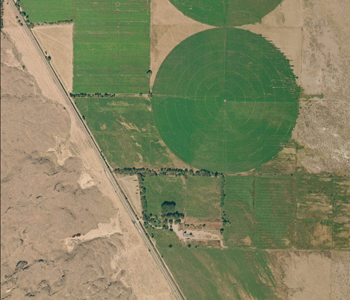
The very nature of producing food and fiber crops generates dust and small particulate matter, commonly referred to as PM10 (Particulate Matter with an average size of 10 microns or less - about one-seventh the diameter of a human hair). For many years farmers have worked to reduce the amount of dust generated from agricultural practices as a means of preserving topsoil, controlling certain dust-loving pest populations and maintaining good neighbor relations.
In California, over the last few years attention has been focused on reducing dust and PM10 emissions from on-farm activities as part of the effort to help improve the state's air quality. Many areas of the state will never attain the federal or state PM10 standards unless agricultural activities implement additional dust control measures. In addition, as more land is developed next to and within agricultural areas, dust that in the past did not impact people in their homes or at their jobs, is now having a direct impact on people's health. In 2004, the state passed a law known as SB 700 that makes agricultural operations subject to the same air pollution requirements as other commercial and industrial operations and requires farm activities to implement additional measures to control air pollution.
The Great Basin Unified Air Pollution Control District (serving all of Alpine, Inyo and Mono Counties) has adopted rules to control dust emissions from agricultural practices in an effort to attain and maintain the federal and state standards for PM10. The rules, Rule 502 (Conservation Management Practices) and Rule 307 (Conservation Management Practices Plan Fee), require farmers to implement and document an annual plan to reduce dust and PM10 emissions from on-farm sources, such as from unpaved roads and equipment yards, during land preparation, harvest activities and from other cultural practices. These plans are known as Conservation Management Practices (CMP) Plans. In order to recover the cost of plan processing and field inspections, the Air District will collect fees from those farms that must comply with the CMP requirement.
What is Required?
Conservation Management Practices Plan
In order to assist farm operators with the preparation of CMP Plans, the District has prepared forms for Alfalfa (CMP 1) and Field and Row Crops (CMP 2). Additional forms for other crops or operations will be prepared as needed or upon request. The use of these forms is optional. Any form of plan that meets the requirements of District Rule 502 may be submitted.
Each farmer with 40 or more contiguous acres outside residential areas or 10 or more acres near residential areas must complete a CMP Plan. Residential areas are defined as five or more residences within one-quarter mile of the farms boundaries. CMP Plans must include the following information:
- A map of the operation that designates where each CMP is being implemented
- The General Information form (CMP A)
- A form for each crop farmed (numbered CMP forms)
- Confined animal feed operations (CAFOs) are also subject to the requirements of Rule 502. CAFO operators should contact the District before preparing a plan to discuss these requirements.
List of Approved Dust Control Practices and Their Descriptions
List of Approved Dust Suppressants Available For Use to Help Reduce PM10 Emissions From Unpaved Roads and Equipment Yards
The CMPs were designed to reduce air pollution and to provide farmers with flexibility in selecting measures. If a CMP in a category can't be implemented, then a grower may select an alternate CMP from another category. To allow flexibility and innovation, there is an "Other" practice in each category, which may be used if the new practice can show equal or greater emission reductions than the currently approved practice, and is approved by the District's Air Pollution Control Officer (APCO).
Costs & Fees
Every year a CMP Plan annual renewal (call the District to get the current fees quoted)must be submitted to the Air District. The District will invoice approved plan holders for the annual fee. After five years, if there has been no change in the CMP plan and no CMP plan violations, the annual renewal fee will be reduced.
A CMP Plan may be modified and resubmitted to the Air District at no cost anytime a practice or crop has changed. No CMP plan fees will be required if a District Permit to Operate is required for the operation (this would apply to very large operations only).
Contact Information
Email us at permits@gbuapcd.org
Staff Reports
July 7, 2005May 16, 2005
Conservation Management Practices (CMP) Application Forms
CMP A - General InformationCMP 1 - Alfalfa
CMP 2 - Field and Row Crops